
Washington Dossier, a magazine that was started in Washington DC in 1975, and which folded in the late 80’s, did not own any of the assignment photography it commissioned. She did not want to make that same “mistake”, and wanted to own, outright, all the images she commissioned me, and others to produce.
I sat on her couch, in her living room, and contemplated my situation, as the grandfather clock ticked off the seconds, and the minutes passed. What should I do, I thought. Tick-tock, tick-tock. Tick…
(Continued after the Jump)
I said to her that I understood her position as a business, wanting what she had been paying for for one use, and re-paying for re-uses, and further, to have an asset to value. But, I relied on my re-licensing to her, and I did not want to be in a position where she would become a photo agency, selling, re-selling my images – especially if I wasn’t going to get a portion of those re-uses.
“We’re not going to do that”, she responded.
“But you could.” I noted.
“We just don’t want to have to deal with photographers in the future to re-use photos we hired them to take in the first place”, she said.
And, on that point, I said “well, we’ll have to agree to disagree, and while I respect your position as a businessperson to require this, as the person who would be responsible for providing that content, I just can’t do that.” That, is exactly what I said. And that was the end of the conversation. They’ve surely had a collection of photographers over the years who have signed those agreements, and that’s fine for them. Not for me.
Over the years, I’ve seen many photo credits outside of Washington Life. An example By photographer Tony Powell, seen in this brochure for the Shakespeare Theatre.
They frequently appear on blogs, like TV Newser, here, and also of Sen. Harold Ford, in an an image here.
And when the Smithsonian had a fiasco on it’s hands with a senior staffer who had allegedly abused her expense account, the cover photo and other images of their cover girl Pilar O’Leary got re-used with the photo credit of “Washington Life.”, in many places, including the Washington Post, as seen here, and other places.
I have seen and heard colleagues try to justify their work for the likes of Vanity Fair, and other Conde Nast publications. Now, starting slowly, VF is selling prints from their past assignment work in their Vanity Fair Store, as shown here:
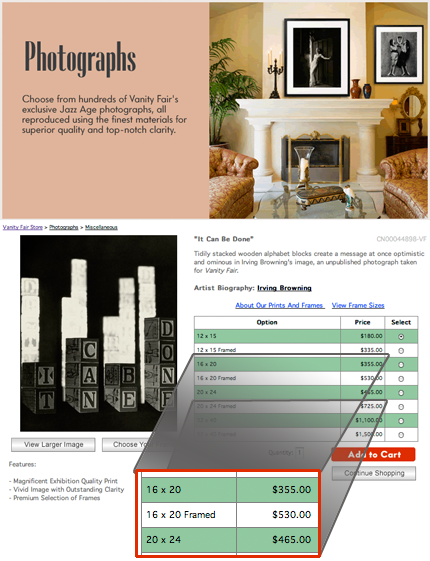
Those are very respectable prices – yet the photographers, atleast under the terms of the agreements they sign for assignments now, are not entitled to a dime from the sales of those prints. Next up will be more recent prints, you can bet on it.
So too, are images available for sale from the Encyclopedia Britannica image archives, as About The Image reported here. 55,000 images, over two-thirds digitized, and ready to e-mail to you!
When clients tell you they need all rights, copyright transfers, work-made-for-hire, and so forth, and tell you they’ll never do anything with them “we just need to get all the rights…”, it’s highly likely they are mis-informed, or just not telling the truth.
Please post your comments by clicking the link below. If you’ve got questions, please pose them in our Photo Business Forum Flickr Group Discussion Threads.
Originally published on Photo Business News & Forum on August 4, 2008. Comments are closed; this post is part of the archive.
You’re preaching to the choir, but………….
I can’t tell you how many young upstart photographers, students of photography, photojournalists, and “weekend warriors” call me for council and AFTER I WARN THEM ABOUT THIS ISSUE THEY GO OUT AND DO JUST THAT.
I’m sorry but I’ve spoken to these colleagues numerous times until I’m blue in the face but yet they not only sign away all of their rights, but some of them do the job for free and/or for the photo credit.
I’m glad that there is finally a backlash and viewable figures that these misguided souls can see; and I hope that they realize that those nice folks that so gently took their rights and photographs from them, are benefiting from the photographer’s sweat.
Was there any of that kind of talk – defusing the “we just might want to reuse them, we don’t want to be a stock agency” approach?
M
IMHO, most buyers across the board are of the belief that if your stupid enough to believe what their dishing out or desperate enough to want to be there, They really are not lying, they are just smarter than you.
Wolves in sheeps clothing.
kjm
They agree to it and I am happy.
TS
Yes, we’d discussed re-use, in fact, they’d paid previously. They wanted the same fee to apply to all uses – and ownership – and there was no movement on that.
– John
It seemed pretty likely that that was the case. I just wanted to be sure I wasn’t getting the impression that they were being even more greedy than they actually were.
I personally, especially since I represent a content buyer for my “day job,” can’t blame a business for trying to get the most bang for its buck. That doesn’t mean that as a content provider, I have to give them valuable copyrights for assignment fees. Unlike the woman in your example, we are always ready to negotiate.
M
They sprang upon her their desire for a single flat rate for all sizes of reproduction (excepting magazine covers) and including continued free use in the table of contents. Pressured to make an immediate decision, she too readily agreed.
I just yesterday received an e-mail from a client that wants to license an image that I licensed to them 5 years ago for ANOTHER 5 YEARS.
If I was to have “rolled over” and given away my copyright when I first shot the assignment 5 years ago; this is income that I wouldn’t be seeing for the last 5 years let alone the next 5 years.
All I can say is be wise with your copyright; it is something of value and something that you should consider very seriously NOT giving away.
I’ve brought similar rebuttals to clients, esp. non-profits. I’ll usually phrase it along the lines of, “agree to any use by you and your company, for any materials you actually produce.” That way, if we can eliminate any 3rd party use or licensing, that takes away a sizable concern.
File under: “Clients; give them what they want and need, but not more…and charge accordingly.
You can always ask for, or require a clause that restricts use to client only, and eliminates any and all 3rd party use(s). This way your client could have what she wanted, and you’d have relief from the fear that she could potentially act like an agent and start reselling images.
(Hoping this comment gets through…)
クレジットカード 海外旅行保険
結婚指輪
育毛剤
薬剤師 求人
ワンクリック詐欺
債務整理
toefl
個別指導塾
幼児教室
合宿 免許