
 There are lots of topics on the subjects of rights I could discuss, though this wouldn’t normally be one. But as it deals with the business of being a photographer, it deserves our attention. It’s when a photographer is alleged to have violated the human rights of someone else.
What’s that you say? Aren’t we supposed to be the defender of the downtrodden, the under-served, the discriminated against?
Yes, one photographer has been taken to task for alledgedly discriminating against the rights of another, a prospective client, for religious reasons – the photographer’s religious reasons.
(Continued after the Jump)
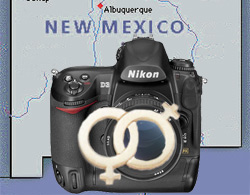
The Washington Times reported (Artist hit for refusal on beliefs, 2/25/08) that an evangelical Christian photographer is being charged with violating the rights of a lesbian couple who wanted to have Elaine Huguenin, who is based in New Mexico, photograph their commitment ceremony.
Now, before I continue, let me say one thing – at no time in this article am I (nor should you) going to take a position on the issue of Huguenin’s religious beliefs, nor on the couple’s ceremony. If you decide to make this about that in the comments, not only are you missing the point of this piece, you’re comments will be subject to deletion. I was going to turn on moderation of comments, but thought better of that.
Had the photographer – who is in the business of providing photographic services to couples – simply decided, in her own mind, that she objected to these specific types of ceremonies, simply said “I don’t think I would be a good fit for your ceremony”, or even said she had other obligations, that would have been the end of it. Instead, the photographer opted to leave a paper trail, of sorts, in the form of an email to the prospective clients, regarding her religious objections to a same-sex ceremony, and thus, indicated that her intention to not provide professional services to this couple was based upon this position. A statement that, in many jurisdictions, can be interpreted (and has successfully been, in courts-of-law) as discriminatory.
Are there many, many other photographers in the Albuquerque area that could provide as good as, if not better, services than Huguenin? Surely that’s the case. Why did this couple decide to bring this case before a state tribunal? Because refusal of service could very well be discriminatory, when made by the owner of a business.
Yes, you’re a business, just like the malt shops who wouldn’t serve blacks in the 60’s – they were in the wrong. You’re a business, just like those that might refuse an interracial couple from enjoying a romantic dinner in their restaurant. Those that would do so would be found to be in the wrong. You’re a business, just like those that would refuse a muslim service after 9/11, they were found to be in the wrong. Federal laws have jurisdiction over civil/human rights issues, where people are discriminated on the basis of race, color, creed, religion, and sexual orientation.
The defense’s position, according to the Times, is that “Elane Photography is basically a husband-and-wife small, little commercial photography business” run by “devout Christians who have a variety of things they don’t want to take pictures of.” This is acceptable where, say, they don’t want to do boudoir photography. Or, perhaps, produce pictures which depict a burning cross, and so forth. But is it, in this case? The defense goes on to suggest “…’the First Amendment protects artists like Mrs. Huguenin from being compelled by the state to engage in expression that violates their religious convictions.’ The First Amendment ‘is pretty clear that Christians should not be penalized for abiding by their beliefs,’…”, and so, an interesting twist is added when we begin to discuss the compelling of an artist to make expressions that they believe violates their religious convictions.
This isn’t, in the end, the same as the sale of a tangible product like a chocolate malt, or an appetizer and main course.
Remember – you are a business. And, your business falls under anti-discrimination laws just as any other “small, little commercial photography business” falls under laws that preclude the dumping of film chemicals down the drain into city water, or handicap-access to your storefront studio in that quaint downtown shopping district in Anytown USA.
Does the state have a case? Maybe, with the laws written as they are, and precedents set where other businesses have been found liable for discriminating. If the state’s position is that refusal of service is comparable when made on racial grounds, as it is when made against a homosexual couple, then it’s not a maybe-they-have-a-case, then they do. And it’s one which will drag out in the courts for years, or get settled for a significant dollar figure. Will this photographer spend a great deal of time defending her religious position? Yes. In the end, will the photographer prevail? I don’t know.
Please post your comments by clicking the link below. If you’ve got questions, please pose them in our Photo Business Forum Flickr Group Discussion Threads.
Originally published on Photo Business News & Forum on February 27, 2008. Comments are closed; this post is part of the archive.
We should all find it alarming that the government can in effect compel private parties to enter into contractual arrangements against the wishes of one of the parties, by penalizing that party’s refusal to provide those services. I don’t condone their refusal, but the government has no business involving itself in transactions between private individuals or entities.
If a business’s practices are found egregious by a sufficient proportion of its potential customer base, it will soon fail, and the market will have spoken. The customers were free to vote with their feet and dollars by finding a more willing photographer.
If the couple had right to choose gender of partners, in my opinion, so does have a photographer right to choose.
And as much that couple have right to say loud their orientation, without of fear that someone would say something bad about them, the same must apply to photographer.
Although, truly, he/she could just say – no, I don’t want to participate. And if asked, to reveal his/hers feeling towards such events (or whatever).
In order to be short let me say that the pair is free to engage in mariage (or whatever they call it) as much as photographer is free to refuse to take picures of them, if that special situation is against his/hers religious position.
What’s not to be missed here, as pointed out by John (and their attorney) is that if photography is an art form, and the product the couple wanted to purchase indeed an expression, is it ok to say what they are and are not be obliged to create with their talent?
In other words, there’s a difference between quietly finding a way not to take on a client you don’t want to take on, and taking a stand that you can reasonably foresee will provoke a conflict. I don’t know if the photographer wanted that conflict, or merely desired to share her religious beliefs with a potential client (always unwise, IMHO) without regard for the consequences. Nevertheless, here we are.
From the client’s side of the picture, I have to wonder why the clients didn’t just go looking for another photographer. It seems to me as though they, too, have turned this case into a bigger issue than it needed to be. If your photographer is incompatible with the job you have for her to do — for whatever reason — the answer in my mind is simple: Pick another photographer and move on.
So, from where I sit, both parties have contrived together to create an unnecessary legal battle that could have been avoided in the first place if either one of them had been possessed of a little more forethought. I don’t see any winner in that, no matter how the legal case comes out.
On the other hand, the lawsuit is a good thing to the extent that some people will change their way of thinking based on authority (in this case the courts) telling them what’s socially acceptable. Of course this won’t happen with everyone but in some areas, it’s surprising; for example, racial integration in the army went much better than people predicted, and we learned that soldiers mostly just needed to be told to deal with it. In the civilian space, sexual harassment suits have changed workplace attitudes and actually made (some) people think about the basis of the problem.
There are certainly places where this law should be enforced and where a suit is appropriate, such as a public PLACE of accommodation (the original example of a restaurant is a bit of a red herring here) or necessity (if they were the only photographers for miles, or if it were medical care instead of photography). I’m not sure this is one of them. But that’s not to say some long-term good won’t come of it.
Christian landscaper won’t soil hands with work for ‘gay’ clients
“A Houston landscaping company is under fire for turning down a job because its Christian owners have a policy of not working for homosexual customers – a decision that has spurred calls for a boycott and an anti-discrimination ordinance that would prevent them from selecting clients based on sexual orientation.
“‘We sent e-mails to several local landscaping companies asking for quotes…Michael was asked if ‘his wife would be home’ when the consultation would take place…Michael said, ‘No, but my partner Gary will be’…a few minutes later we got the e-mail:’
“‘Subject: Cancel Appt Garden Guy
Dear Mr. Lord,
I am appreciative of your time on the phone today and glad you contacted us. I need to tell you that we cannot meet with you because we choose not to work for homosexuals.
Best of luck in finding someone else to fill your landscaping needs.
All my best,
Sabrina
Todd and Sabrina Farber
Owners, Garden Guy, Inc.”
Similarly there are the Muslim taxi drivers who will not carry a passenger who is carrying alcohol.
On the photographer’s choice side I would really hate to have a precedent set that I can’t choose not to take a job because I have a moral objection to it.
From the discrimination side, yeah, absolutely, they were denied a service by their chosen provider on the grounds that it was not a traditional marriage. What really catches me on this, they could have just said “We are unavailable for that date” and, as ron comments, the couple could have simply avoided a photographer that would have been uncomfortable and possibly couldn’t get acceptable photos. But, to say “We can’t take your picture because you are homosexual” is just taking the opportunity to give them a slap in the face.
So, I’m going to declare that I am both a Christian and going to agree with ron. While this might specifically be a poor example, because photography is non-critical and there were a wide selection of photographers in the area, we do seem to need anti-discrimination laws to get people to understand that *shock* other people are also people and deserve the same considerations we would want. And that goes both to businesses and to clients.
Saying that I won’t cut your lawn because you’re gay seems completely unacceptable to me. It’s treating the person as unworthy. However, I feel that being forced to be the photographer at a gay wedding seems like a different matter. If I feel that homosexuality is not right (and yes, I don’t feel it is), I’m probably not your best choice to take romantics at your wedding, and I don’t think that I should be compelled to do it. If you want to have a portrait done in my studio, that’s a totally different matter, and I have no problem with that.
I don’t buy the argument that all it takes is to not say why. If Christians (and, by the way, adherents of many other religions would agree) will make a point of stating their beliefs, and then refuse without giving a reason, there’s still going to be a lawyer that will say, “this is why they refused.” And whether or not the lawyer has a case, she or he may still ruin your business.
Please don’t get me wrong. Of course you should do it when it’s necessary, but I’m just pointing out that sometimes people sue for the most minimal reasons as if it was the ultimate insult in the world and your life can’t go on without a court solution. Like you can’t solve troubles on your own.
Anyway.
Obviously, the most clever way to act was to simply decline the job by saying you had other jobs that day, as many people have already pointed out. But who knows, maybe the couple could have smelled the lie and sued the photographer anyway for discrimination.
I mean, they’re gay, so probably everyone hates them and wants to discriminate them, right? (*irony*)
It seems to me that nowadays we are all very touchy about discrimination issues, and it seems like if you’re gay, you can go suing everyone easily for discrimination, and you’re very likely to win, cause if you loose, there will be some nasty riots and passionate debates about it so the whole country will know how insensitive your court is, and what an inconsiderate society we live in.
I think the photographer was in a loose/loose situation anyway. Whatever way of declining the job was risky.
On the other hand, if I was the couple, I would just get away from that photographer and find a nice one for my wedding. I mean, if she declined because she doesn’t like us being gay, obviously, you don’t want her around (neither shooting those important pictures!) on your special day.
I think that if you’re truly concerned about the ceremony pictures, you will most likely spend your energies in finding a good photographer that’s comfortable shooting for you that day (just like Ron said), not suing the other one… but who knows, maybe this couple needed money for the party, or they were just very touchy about the subject…
Here lies a question of booking order etiquette. Should I as a photographer get the details of what the potential client wants first before I ask the date. What if I ask the date first then hear out the client’s needs and find out a conflict of interest. Then I refuse to take the job with a “not available” answer. Have I opened myself up to prosecution anyway? If I new the date was not available I should have stated that right up front. This leaves me at a disadvantage to speculation of discrimination, doesn’t it?
Lastly, what if I book a job and find something at the session or job that I as a conservative Christian am not comfortable shooting. Such as a senior portrait of a female who comes out dressed in a bikini, low-rise pants, midriff shirts, daisy dukes, etc… Good business sense says take the shots of what the customer wants and call it a day, but this type of clothing is not part of my business model and could be detrimental to its reputation. I admit this is by my moral standards, but could be of many of my friends and family in Christ (all potential clients). How do I handle the situation of a surprise line that I want to draw while on the job?
If you can’t provide service to the public, don’t open a business.
I myself am a Christian, but I am also a bi-sexual.
So you can already guess my opinions on things like this.
But I do believe the photographer AT LEAST owes a MAJOR apology to the couple….they have feelings and that’s the worst part.
Someone was hurt in this.
But nonetheless, she’ll have really bad publicity over this one.
Just goes to show….think before you act.
クレジットカード 海外旅行保険
結婚指輪
育毛剤
薬剤師 求人
ワンクリック詐欺
債務整理
toefl
個別指導塾
幼児教室
合宿 免許